
Asbestos was used in New Zealand building products up until 2000, so any house built or altered before then could contain it. On roofs it most often turns up in corrugated fibre cement sheeting, commonly called Super Six, and in the bitumen coating of some older decramastic tiles. WorkSafe describes Super Six as a product that has reached the end of its economic life.
Left alone and intact, asbestos roofing is generally low risk. The danger comes when it is broken, cut, drilled, water blasted or removed carelessly. Replacing one of these roofs has legal requirements at every step, and this page explains them. If your roof is decramastic, see our decramastic roof replacement page.
Pricing: every roof gets a free on-site measure and an itemised written quote, with a fixed price agreed before any work starts.
Older Wellington homes and fibre cement roofs
Much of Wellington's housing pre-dates 2000, from inner-city villas and workers' cottages to the state housing built from the late 1930s onwards, including the first state house in Miramar, the planned suburb of Naenae and the 1950s state housing in Porirua. Over the decades many of these homes have had garages, lean-tos, sleep-outs and extensions added, and any of those may have been roofed in fibre cement.
You cannot confirm asbestos by looking. Grey or white corrugated sheets that are hard and brittle, often with a slightly dimpled surface, on a building put up or reroofed before 2000, are worth testing. Fibre cement made later without asbestos can look very similar, so until a lab says otherwise, treat it as if it does contain asbestos.
- Do not water blast, scrub or walk on the roof
- Do not drill, cut or screw into the sheets
- Do not sweep or vacuum up broken pieces after a storm
- Do book a test before any roofing, spouting or ceiling work begins
What WorkSafe requires for removal
Asbestos removal is regulated under the Health and Safety at Work (Asbestos) Regulations 2016. WorkSafe issues two types of removal licence. A Class A licence covers any type and amount of asbestos, including friable asbestos. A Class B licence covers non-friable asbestos, which is what most intact roofing sheets are.
Removing up to and including 10 square metres of non-friable asbestos, counted across the whole job, does not need a licence, although it must still be done safely. A whole roof is far larger, so it must be removed by a licensed removalist, who must notify WorkSafe in writing at least five days before the removal starts.
We arrange removal through WorkSafe-licensed removalists who handle testing, notification, removal, disposal and clearance, and we time the job so the new roof goes on straight after.
How It Works
How an asbestos re-roof runs in Wellington
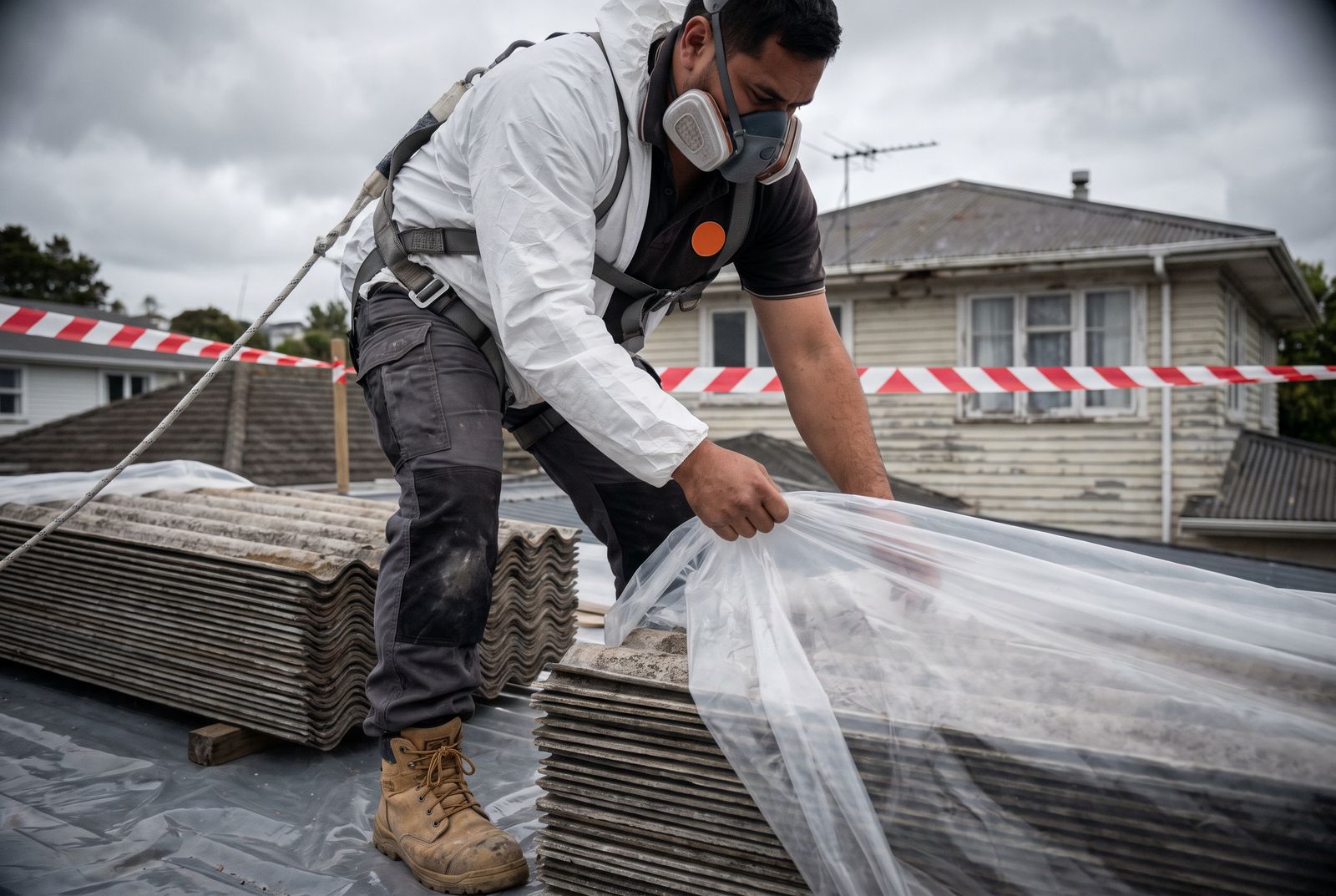
The job runs in two stages with a clear handover. First the licensed removalist sets up the work area, wets the sheets at low pressure to keep fibres down, removes them whole wherever possible, wraps them and takes them to an approved disposal site. Waste is never broken up or left loose on site.
Wind shapes the schedule here. Large sheets are hard to handle safely in strong gusts and wrapped waste must stay sealed, so removal days are planned around the forecast, and on exposed hillside or coastal sites that can mean waiting for a calmer window. Where a house has steep or no vehicle access, the removalist plans how wrapped sheets will be carried down to the road before the job starts.
Once removal is complete and the area is cleared, our roofing team takes over. We check the purlins and rafters, lay new underlay and install the new COLORSTEEL roof, with purlin spacing and fixings set for your NZS 3604 wind zone. The rest of the process is on our re-roofing page.
Cost factors for asbestos roof replacement
An asbestos re-roof costs more than a standard steel re-roof because removal, disposal and clearance are specialist work. The main factors are roof area, the condition of the sheets, access, how much can come off in whole sheets, disposal and how much timber needs replacing underneath. On harbourside and coastal sites, the steel product your exposure zone needs also affects the roofing side.
You get one itemised quote that shows removal and re-roofing as separate lines. Our roof replacement cost guide explains the roofing side in more detail.
Consent and paperwork
Asbestos removal is controlled by WorkSafe rather than building consent. The re-roof is assessed separately: replacing a roof with a comparable one in the same position is often exempt under Schedule 1 of the Building Act, but a change of material or structural work can mean consent is needed from your council, whether that is Wellington City, Hutt City, Upper Hutt, Porirua or Kāpiti Coast. We confirm what applies before quoting.
Keep every document: test results, the removalist's details, the clearance and the records of the new roof. Buyers, insurers and building inspectors may ask for them. For local detail on older housing, see roofers in Porirua.
Why Choose Cheeky's Roofers for Asbestos Roof Removal
Test first, always
We never quote removal on a suspected asbestos roof without a lab result, and we never disturb it to look.
Licensed removalists
Removal is done by WorkSafe-licensed removalists, with notification and clearance handled properly.
Planned around the wind
Removal days are booked for workable weather, so sheets and wrapped waste are handled safely.
Paperwork you keep
You get the test results, removal records and roof details in one place for future buyers and insurers.
Asbestos Roof Removal FAQs
Is my Super Six roof dangerous?
Intact asbestos roofing in good condition is generally low risk if left alone. The risk rises when it is broken, cut, drilled or water blasted, which releases fibres.
A storm has broken part of my fibre cement roof. What should I do?
Keep people away from the broken pieces, do not sweep or vacuum them, and call for a make-safe. Treat the debris as asbestos until it has been tested.
Can I remove the asbestos sheets myself?
Not for a whole roof. Removing more than 10 square metres of non-friable asbestos requires a licensed removalist.
How long does an asbestos re-roof take?
Allow for testing, the five-day notification before licensed removal, the removal and clearance, then the re-roof. Wind can add waiting days. Your quote sets out the expected timeline.
Do I need to leave the house?
Usually not, but follow the removalist's instructions about windows, doors and access on the removal days.
Does decramastic contain asbestos?
Some older decramastic tiles have tested positive for asbestos in their bitumen coating. Test before any work.
Asbestos Roof Removal Across Wellington
We cover every region: Central Wellington, the Eastern and Southern Suburbs, the Western and Northern Suburbs, the Hutt Valley, Porirua, the Kāpiti Coast.
Related Roofing Services
See the roof replacement cost guide or every service we offer.
Sources and further reading
- WorkSafe: Asbestos licensing overview
- WorkSafe: Duty to notify licensed asbestos removal
- WorkSafe: Asbestos licensing FAQs
- WorkSafe: Asbestos information for builders (Super Six)
- WorkSafe: Check for asbestos before high-pressure spraying on roofs
- Heritage New Zealand: First State House, Miramar
- Kāinga Ora: History of state housing
- MBIE building.govt.nz: Exemption 1, general repair, maintenance and replacement
- Level (BRANZ): Wind zones