
The fascia is the board that runs along the edge of the roof, closing off the rafter ends and carrying the spouting brackets. The downpipes are the vertical pipes that take everything the spouting catches down to the ground. Neither gets much attention until something goes wrong. A fascia that has rotted from behind lets the brackets pull out and the gutter drop. A downpipe that splits, blocks or empties onto the ground sends water against the cladding, under the floor or down a bank.
We replace and repair both, on their own or as part of new spouting or a full re-roof. Rot in a fascia board usually only shows once the old gutter is off, so we check the timber properly during any spouting job and price the repair before work starts, not halfway through.
Pricing: every roof gets a free on-site measure and an itemised written quote, with a fixed price agreed before any work starts.
Need the gutters themselves replaced or resized? See spouting and gutters.
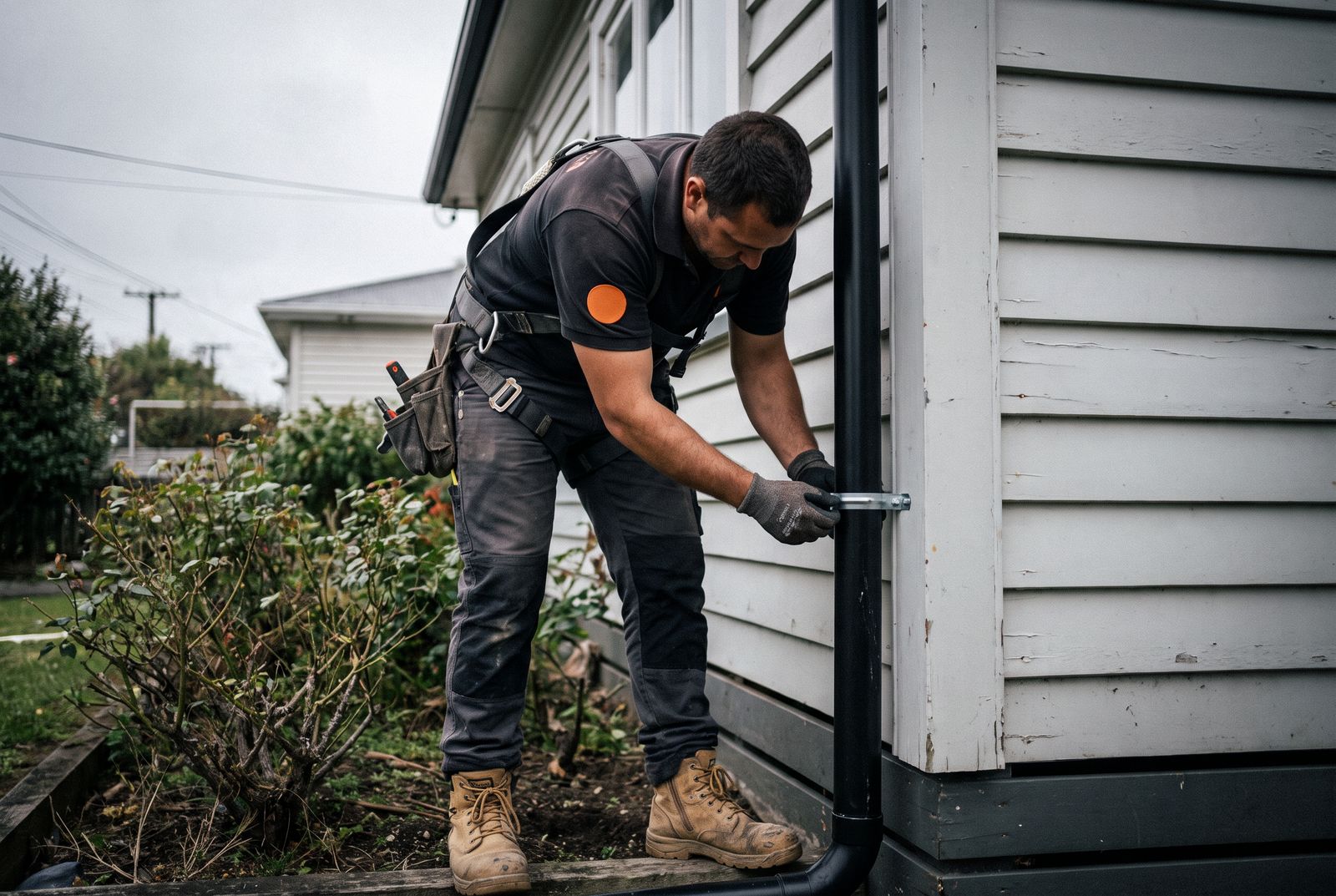
Signs your fascia or downpipes need work
Most fascia and downpipe trouble comes from water sitting or running where it should not. Things to look for from the ground:
- Peeling paint, dark staining or soft timber on the fascia, especially behind gutter joints and at corners
- Spouting that has dropped, twisted or pulled away from the board
- Downpipes leaking at joints, split along a seam or loose from the wall
- A downpipe that ends above a path, a bank or a gully trap rather than in a stormwater connection
- One section of gutter that overflows in heavy rain while the rest copes, often a blocked or undersized outlet
- Brackets, clips and screws streaked with rust, a common sight close to the harbour
Fascia repair and replacement
Timber fascia is still on a great many Wellington houses, from the villas and workers' cottages of Newtown and Mount Cook to the post-war homes of Naenae and Porirua. Paint keeps it sound, but once a gutter joint leaks behind the board the timber rots from the back, out of sight. We take the spouting off, probe the board along its full length and replace any soft sections with treated timber, primed on every face before it is fixed.
When most of a run is affected, full replacement is usually better value than patching. Some homes suit a steel fascia cover or a fascia gutter profile that combines board and gutter in one, which takes timber out of the weather. On character homes in suburbs such as Thorndon, Mt Victoria and Newtown, it is worth checking whether the house sits in a Wellington City Council character precinct before changing how the roof edge looks. We talk through the options and the finish you want before quoting.
How It Works
Downpipes, stormwater and Wellington hillsides
Every downpipe needs somewhere proper to go. Tiaki Wai, which runs water and stormwater for Wellington City, Lower Hutt, Upper Hutt and Porirua, says roof downpipes must connect to the stormwater system, not wastewater, and that a downpipe feeding a gully trap needs redirecting to stormwater. On the Kāpiti Coast, stormwater is run by Kāpiti Coast District Council. Private drains on your own land are generally the owner's responsibility, and Upper Hutt states that stormwater laterals are always the owner's job down to the point of discharge.
On sloping sections the outfall matters even more. GeoNet linked many of the slips after Wellington's very wet July 2022 to saturated ground and older cut and fill slopes. A downpipe that empties onto a bank adds water exactly where you do not want it. Moving or adding a downpipe can mean below-ground drainage work, which is drainlaying. Where that applies we say so in the quote and coordinate it, so the water ends up in a proper connection.
Sizing, materials and fixings
A downpipe can only take so much water, and the gutter feeding it can only carry water so far. BRANZ guidance sizes each gutter section from the roof area that drains to it, so an extra downpipe is often the simplest cure for a gutter that keeps overflowing. Outlets near valleys and internal corners help, because that is where water gathers. Rainfall varies a lot across the region: NIWA normals put Wellington Airport at about 957 mm a year, Gracefield in Lower Hutt at about 1,206 mm and the Wainuiomata Reservoir at about 1,800 mm.
Fixings matter in the wind. Wellington Airport records gusts over 63 km/h on about 166 days a year, so brackets and clips need to be spaced to hold pipes straight and tight.
- Round or rectangular downpipes in pre-painted steel or PVC, matched to the outlet
- Brackets and clips spaced closely enough to stay put in a southerly or a nor'wester
- Fixings suited to the corrosion zone, since BRANZ puts homes within 500 metres of the sea, harbours included, in its high exposure zone
- Treated timber fascia primed on all faces, or a steel fascia profile where low maintenance suits
What affects the cost
Quotes are itemised by length and by part. The main factors are how much fascia needs replacing, the number and height of downpipes, the material and profile, any drainage changes, painting of new timber, and access. Many hillside homes in Wellington have steep paths or no vehicle access at all, which affects scaffolding and getting materials to the house. WorkSafe expects scaffolding five metres or more above the ground to be put up by qualified scaffolders. Doing fascia and downpipes alongside new spouting or a re-roof shares that set-up cost.
Across the Wellington region
Coastal homes in Eastbourne, Lyall Bay, Island Bay, Seatoun and Tītahi Bay see brackets and screws corrode faster in the salt air, so we choose fixings for the exposure and suggest rinsing sheltered areas the rain does not reach. Valley and hill homes in Wainuiomata, Stokes Valley and Upper Hutt get more rain than the city and more leaves from surrounding trees, so outlet size and leaf protection count. If you want the whole roof looked at while we are there, a roof inspection covers the roof, spouting, fascia and downpipes in one visit.
Why Choose Cheeky's Roofers for Downpipes and Fascia
Rot found and priced up front
We probe the fascia as soon as the old spouting is off and agree any timber repair before the new system goes on.
Capacity, not just replacement
If a gutter overflows, we check whether an extra or larger downpipe is the real fix.
Water sent to the right place
Downpipes go to stormwater, not a bank or a gully trap, and any drainlaying is flagged in the quote.
Fixings for wind and salt
Brackets, clips and screws are chosen for your exposure, so the job stays tight in a Wellington gale.
Downpipes and Fascia FAQs
How can I tell if my fascia is rotten?
Soft spots, peeling paint behind gutter joints and sagging spouting are the usual clues. Rot often starts at the back of the board, so we check it properly once the spouting is removed.
Can you replace fascia without replacing the spouting?
The spouting has to come off to reach the board, and older spouting seldom goes back up well. Doing both together is usually better value.
Where should my downpipes go?
Into the stormwater system. Tiaki Wai says downpipes must not connect to wastewater, and one that runs into a gully trap needs redirecting.
Who looks after the stormwater pipe from my downpipe?
Private drains on your property are generally the owner's responsibility, and the exact boundary depends on your council. We can point you to the right one.
Do you do the drainage work as well?
Below-ground drainage is drainlaying. If your job needs it, we flag it in the quote and coordinate it so the system is finished properly.
Is a steel fascia worth it?
It takes timber out of the weather and cuts painting, which suits some houses. Character homes often look better in painted timber, so we show you both.
Downpipes and Fascia Across Wellington
We cover every region: Central Wellington, the Eastern and Southern Suburbs, the Western and Northern Suburbs, the Hutt Valley, Porirua, the Kāpiti Coast.
Related Roofing Services
See the roof replacement cost guide or every service we offer.