
Spouting has one job: catch the water coming off the roof and get it to the stormwater system without letting it into the house or onto the ground beside it. In Wellington that job varies a lot by suburb. NIWA rainfall normals show about 957 mm a year at Wellington Airport, about 1,206 mm at Gracefield in Lower Hutt, and about 1,800 mm at the Wainuiomata reservoir. Spouting that copes in Kilbirnie can overflow in Wainuiomata.
We replace and repair spouting across the region, in steel to match your roof or in PVC. Spouting is often best replaced at the same time as the roof, and our re-roofing page covers that. Rotten fascia and tired downpipes usually go with it, and our downpipes and fascia page covers those.
Pricing: every roof gets a free on-site measure and an itemised written quote, with a fixed price agreed before any work starts.
Trouble with the boards behind the spouting or the pipes that carry the water away? See downpipes and fascia.
Gutters in good condition but full of leaves? Clearing them is covered under gutter cleaning.
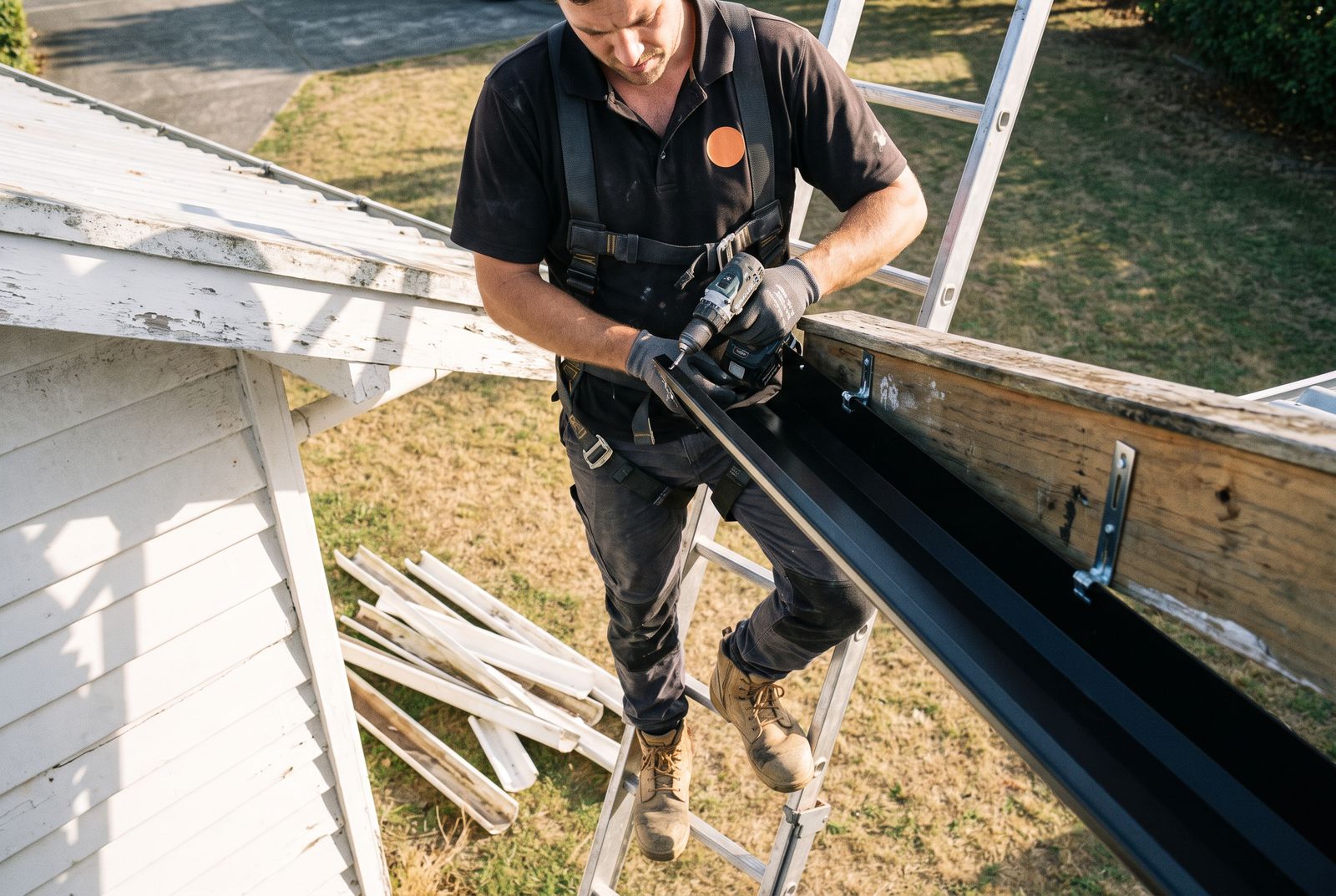
Signs your spouting needs replacing
Spouting usually tells you when it is struggling. Some of these signs can be fixed with a clean or a repair; others mean the system has reached the end of its life or was too small to begin with.
- Overflowing over the front edge in heavy rain, even when clean
- Rust spots, pinholes or splits along the length
- Joints and corners that drip
- Sagging sections where brackets have failed
- Water staining down the cladding below the spouting
- Soft or rotten fascia behind it
- PVC that has gone brittle or warped in the sun
Sizing spouting for Wellington rain
Annual rainfall only tells part of the story. Spouting is sized for short, intense bursts, and Building Code clause E1 Surface Water sizes spouting and downpipes from the roof area they drain and the local rainfall intensity. Much of the region gets between 1,000 and 1,200 mm a year, Wallaceville in Upper Hutt about 1,268 mm, and the Tararua and Remutaka ranges more than 2,000 mm. Winter is the wettest season, and July 2022 was Wellington's wettest July on record.
Spouting on an older home can be fine for an average shower but undersized for a big storm, or have too few downpipes for the roof area. Adding a downpipe or stepping up the spouting profile is often cheaper than living with an overflow that soaks the wall. We check roof area, outlets and downpipe numbers before recommending a size, and in the wetter Hutt Valley and Wainuiomata suburbs we design with more margin. Our Hutt Valley roofers page covers that part of the region.
How It Works
Steel or PVC spouting
Both work well when they suit the site. The choice usually comes down to looks, matching the roof, exposure and budget.
- Steel spouting can be colour matched to a COLORSTEEL roof and is rigid on long runs
- Steel near the sea needs a product suited to the exposure zone and regular washing
- PVC does not rust, which can suit some coastal sites
- PVC expands and contracts more with temperature and needs allowance at joints
- Brackets matter as much as the spouting in high wind, and spacing should suit the site
Coastal corrosion and washing
The inside of spouting stays damp, collects salt and is never washed clean by rain hitting it directly, which makes it one of the first parts of a coastal roof system to rust. Under NZS 3604, sites within 500 metres of the sea, harbours included, are generally Exposure Zone D. That likely includes much of the housing in Lyall Bay, Island Bay, Seatoun, Eastbourne, Petone and Tītahi Bay, though the zone should be confirmed for each address. NZ Steel advises regular washing of steel near the sea, especially areas rain does not reach, such as the underside and back of spouting. Clearing leaves and silt helps too, and our gutter cleaning service covers it.
Hillside sections and where the water goes
On a hillside section, the end of the downpipe matters as much as the spouting. About 670 slips were recorded around Wellington between 1 July and 22 August 2022, and GeoNet linked that year's slips to saturated soil and to older cut and fill slopes. Water discharging onto a bank from a broken or disconnected downpipe can add to that risk. Downpipes should connect to the stormwater system as consented, not spill onto the ground.
Hillside homes in suburbs like Brooklyn, Karori, Ngaio and Stokes Valley can also be harder to reach. Long lengths of steel spouting may need to be carried in by hand, and scaffolding on a slope takes more planning. We look at access during the measure and include it in the quote.
Internal gutters, cost and consent
Internal and box gutters sit inside the line of the building, so when they overflow the water goes inside. They need generous capacity, a lining that suits the fall, and an overflow that discharges outside. Our membrane roofing page covers gutter linings.
The cost of new spouting depends on length, profile, material, the number of downpipes and corners, fascia repairs and access. Replacing spouting with a comparable product in the same position is generally exempt from building consent under Schedule 1 of the Building Act, while changes to stormwater connections may involve your council or Tiaki Wai, which runs the public stormwater network for Wellington City, Hutt City, Upper Hutt and Porirua.
Why Choose Cheeky's Roofers for Spouting and Gutters
Sized for your suburb's rain
We check roof area, outlets and downpipes against local rainfall, not just replace what was there.
Matched to your exposure
Steel or PVC is chosen to suit your distance from the sea and the look of the house.
Brackets for the wind
Bracket spacing and fixing suit the exposure of the site, so spouting stays put in a gale.
Downpipes connected properly
Downpipes are connected to stormwater, not left to spill onto a bank.
Spouting and Gutters FAQs
How do I know if my spouting is too small?
If it overflows in heavy rain even when it is clean, it is likely undersized for the roof area or short of downpipes. Building Code clause E1 sizes spouting from roof area and rainfall intensity.
Does spouting need to be bigger in the Hutt Valley or Wainuiomata?
Those areas get more rain than the airport. NIWA normals show about 1,206 mm a year at Gracefield and about 1,800 mm at the Wainuiomata reservoir, against about 957 mm at Wellington Airport, so capacity deserves a closer look.
Is steel or PVC spouting better?
Steel matches a COLORSTEEL roof and is rigid on long runs. PVC does not rust. The best choice depends on exposure, looks and budget.
Should I replace spouting when I re-roof?
Often, yes. It is easier while scaffolding is up, and new spouting can be matched to the new roof.
Do I need consent to replace spouting?
Like-for-like replacement is generally exempt under Schedule 1 of the Building Act. Changes to stormwater connections may need council input.
How often should spouting be cleaned?
At least once a year, more often under trees. Coastal spouting also benefits from regular washing to remove salt.
Spouting and Gutters by Area
Local spouting and gutters information for your part of Wellington:
Related Roofing Services
See the roof replacement cost guide or every service we offer.
Sources and further reading
- NIWA: The Climate and Weather of Wellington (2014)
- BRANZ: Sizing gutters and downpipes
- BRANZ: Designing gutters to cope with high rainfall
- BRANZ: Internal gutters and flow capacity
- building.govt.nz: Exemption 1.1 general repair, maintenance and replacement
- NZ Steel: Design considerations for steel roofing in very severe environments
- GeoNet: Wellington slips of 2022
- Newshub: Wellington's wettest July on record and slips (2022)
- Tiaki Wai