
Concrete and clay tiles are tough, and the tile itself is rarely the first thing to give up. On a Wellington roof the weak points are the parts that hold the tiles down and seal the joins: ridge and hip bedding, tile fixings, valley irons and the underlay. Strong gusts work on all of them, and wind-driven rain finds any gap they leave.
We repair concrete and clay tile roofs right across the region, from the Hutt Valley and Porirua to the western and northern suburbs. Tiles need careful handling, matched replacements and a fixing method that suits your wind zone. If your roof has reached the point where repairs no longer add up, our tile to metal re-roofing page covers the alternative.
Pricing: every roof gets a free on-site measure and an itemised written quote, with a fixed price agreed before any work starts.
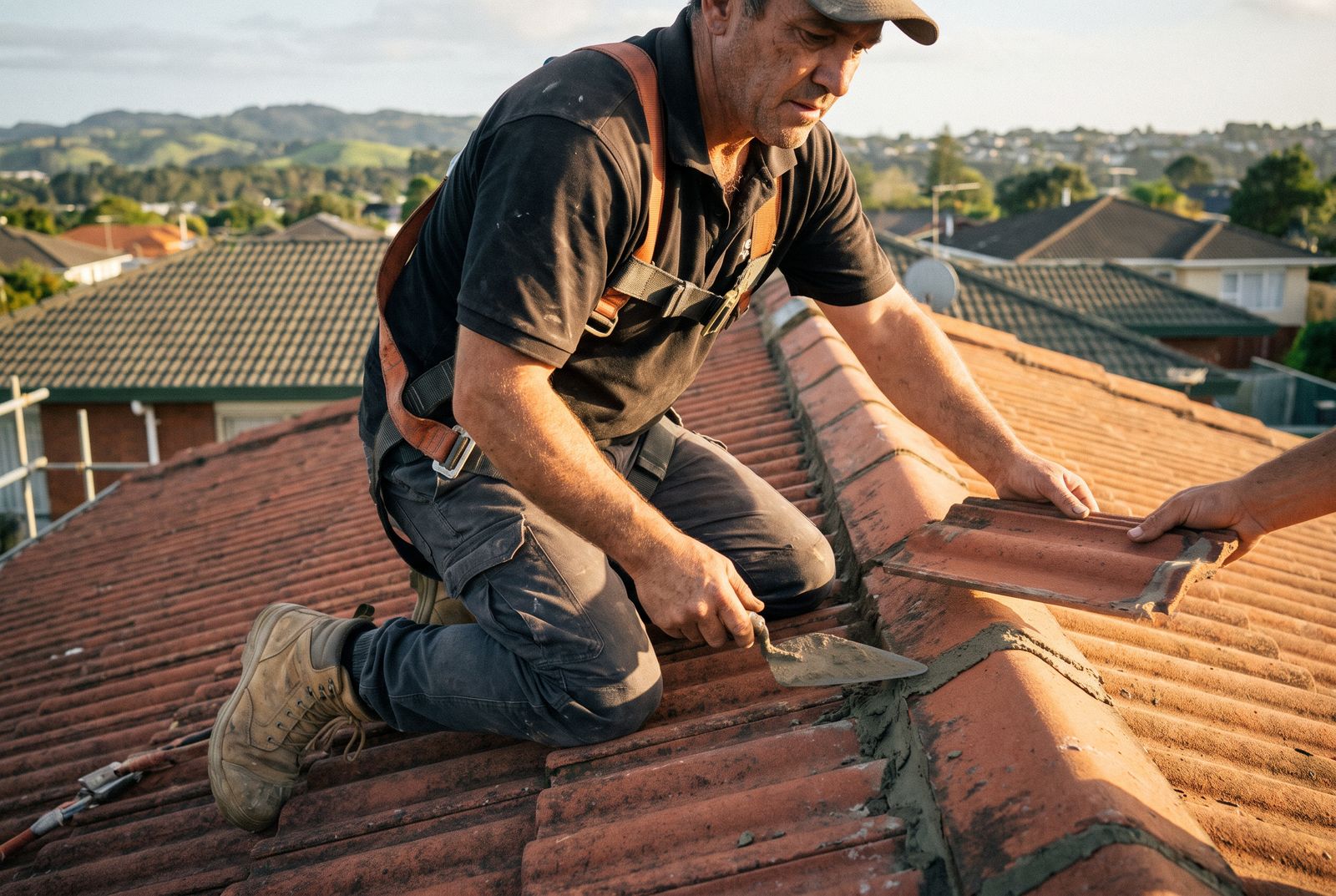
What goes wrong on a tiled roof
Tile roof faults tend to show up in the same handful of places. Ridge and hip caps sit on mortar bedding that cracks with age and movement, which lets the caps rock and eventually lift. Tiles crack under foot traffic or from debris, and they slip when the nails or clips holding them fail. Valleys carry water from two roof planes and collect leaves and moss. Underneath it all, older underlay turns brittle and tears.
- Cracked, broken or missing tiles
- Tiles that have slipped out of line, leaving a gap
- Cracked or crumbling ridge and hip bedding
- Ridge caps that rock or have been lifted by wind
- Rusted, blocked or undersized valley irons
- Moss and lichen holding water against the tiles
- Brittle or torn underlay visible from the roof space
Wind, ridges and tile fixings
Wellington is one of the windiest places in the country to own a tiled roof. NIWA's climate summary for Wellington records gusts over 63 km/h at the airport on about 166 days a year, and over 96 km/h on about 24 days. The highest gust ever recorded at Kelburn, 198 km/h, came in the Wahine storm of April 1968. Paraparaumu on the Kāpiti Coast is far more sheltered, with about 77 days a year over 63 km/h.
That matters most at the ridge. Bedding that has cracked lets a cap move a little in every gust until it breaks free. When we rebed a ridge we lift the caps, remove the old bedding, re-lay them on fresh bedding and fix them mechanically, then point the joins. NZS 3604 places sites in wind zones from Low to Extra High, and some need specific design. Many hillside and exposed sites around the harbour sit in the higher zones, so we check the zone for your address before deciding how the caps and loose tiles are fixed.
How It Works
Replacing cracked and slipped tiles
One cracked tile can let in more water than you would expect when rain is driven sideways across the roof. To replace it we lift the tiles around it, take out the broken one, fit a matching tile and check the underlay and batten underneath before closing up.
Matching is the hard part on an older roof, because many concrete tile profiles are no longer made. Options include second-hand tiles of the same profile, or moving sound tiles from a less visible area and filling those gaps with the nearest match. New tiles also look brighter than weathered ones for a while. We tell you what match is possible before we quote, so there are no surprises on the day.
Leaks, valleys and moss
A leak under a tile roof rarely sits directly above the stain on your ceiling. Water runs under laps and along battens before it drops, so we trace it from the roof space wherever access allows. Valley irons and the flashings where tiles meet walls and chimneys are common sources. Our roof flashing repairs page explains those details.
Moss and lichen hold moisture and can lift tile edges far enough for wind-driven rain to get under them. Cleaning helps, but water blasting older concrete tiles can damage the surface and push water under the laps. If your roof is decramastic rather than concrete or clay, do not water blast it until it has been tested for asbestos, as WorkSafe warns. See roof cleaning and moss treatment for the right method.
Getting onto hillside tile roofs
A lot of tiled homes in suburbs like Karori, Khandallah, Brooklyn and Stokes Valley sit above or below the road, with steep paths or steps and no vehicle access to the house. That shapes how a repair is done. Tiles, bedding and tools may need to be carried in by hand, and scaffolding on a sloping section takes more planning than on flat ground. We look at access during the inspection and build it into the quote, so the price you see includes getting the job done safely under WorkSafe's guidance for working on roofs.
When repairs stop making sense
Tile repairs are good value when the problems are confined to one area. When ridges need rebedding again, tiles crack every time someone goes up, the underlay has broken down across the whole roof or the valleys are rusted through, repeat repair costs start to approach a re-roof. Building Code clause B2 sets a 15-year minimum life for roof cladding, but the life left in your roof is best judged on site. We show you the evidence and, where it is relevant, price both options. Our roof replacement guide covers the decision in more depth.
Why Choose Cheeky's Roofers for Tile Roof Repairs
Careful on tiles
We step only where a tile roof can take the weight, so fixing one problem does not crack three more tiles.
Fixed for your wind zone
Ridge caps and loose tiles are mechanically fixed to suit the wind exposure of your site, not just re-mortared.
Tile match confirmed first
We confirm what replacement tiles are available before quoting, so you know how the repair will look.
Photos from above and below
You get photos of the tiles and, where accessible, the underlay and battens from inside the roof space.
Tile Roof Repairs FAQs
What is the difference between repointing and rebedding?
Repointing seals over bedding that is still sound. Rebedding removes the old bedding under the ridge caps and re-lays them on fresh bedding. If the bedding is cracked or loose, repointing alone will not last.
Why do my ridge caps keep coming loose?
Usually because the bedding has cracked and the caps were never mechanically fixed. In Wellington wind, a loose cap moves in every gust. Rebedding with mechanical fixing is the lasting repair.
Can you match my old roof tiles?
Often, using second-hand tiles of the same profile or by moving tiles from a less visible area. Some older profiles are hard to find, and we confirm what is possible before quoting.
Should I water blast my tile roof?
Not without care. High pressure can damage older concrete tile surfaces and drive water under the laps. Decramastic roofs must not be water blasted until they have been tested for asbestos.
Is it worth repairing a tile roof or should I go to steel?
If the problems are local, repair. If the underlay, valleys and ridges are all failing at once, a tile to metal re-roof may be better value over the long term.
Do tile roof repairs need building consent?
Generally not. Repairing or replacing roof components with comparable materials in the same position is usually exempt under Schedule 1 of the Building Act. Your council can confirm for your property.
Tile Roof Repairs Across Wellington
We cover every region: Central Wellington, the Eastern and Southern Suburbs, the Western and Northern Suburbs, the Hutt Valley, Porirua, the Kāpiti Coast.
Related Roofing Services
See the roof replacement cost guide or every service we offer.
Sources and further reading
- NIWA: The Climate and Weather of Wellington (2014)
- BRANZ: Wind zones and NZS 3604
- MBIE building.govt.nz: B2 Durability
- MBIE building.govt.nz: Exemption 1, general repair, maintenance and replacement
- WorkSafe: Check for asbestos before high-pressure spraying on roofs
- WorkSafe: Roof restoration and maintenance
- Wellington City Council: Building and resource consents