
Most roofs do not need replacing when something goes wrong. A loose sheet, a lifted flashing, a few corroded screws or a cracked tile can be repaired for a fraction of the cost of a new roof, as long as the repair uses the right materials and deals with the cause, not just the symptom.
We repair steel, concrete tile, clay tile and decramastic roofs across the Wellington region. Every repair starts with an inspection and ends with photos of what we found and what we fixed. If water is already coming in, go straight to our roof leak repairs page. If the damage came from a gale or a falling tree, see storm damage roof repairs.
Pricing: every roof gets a free on-site measure and an itemised written quote, with a fixed price agreed before any work starts.
Water coming through the ceiling right now? Tracing and fixing an active leak is covered under roof leak repairs.
Common roof repairs we carry out
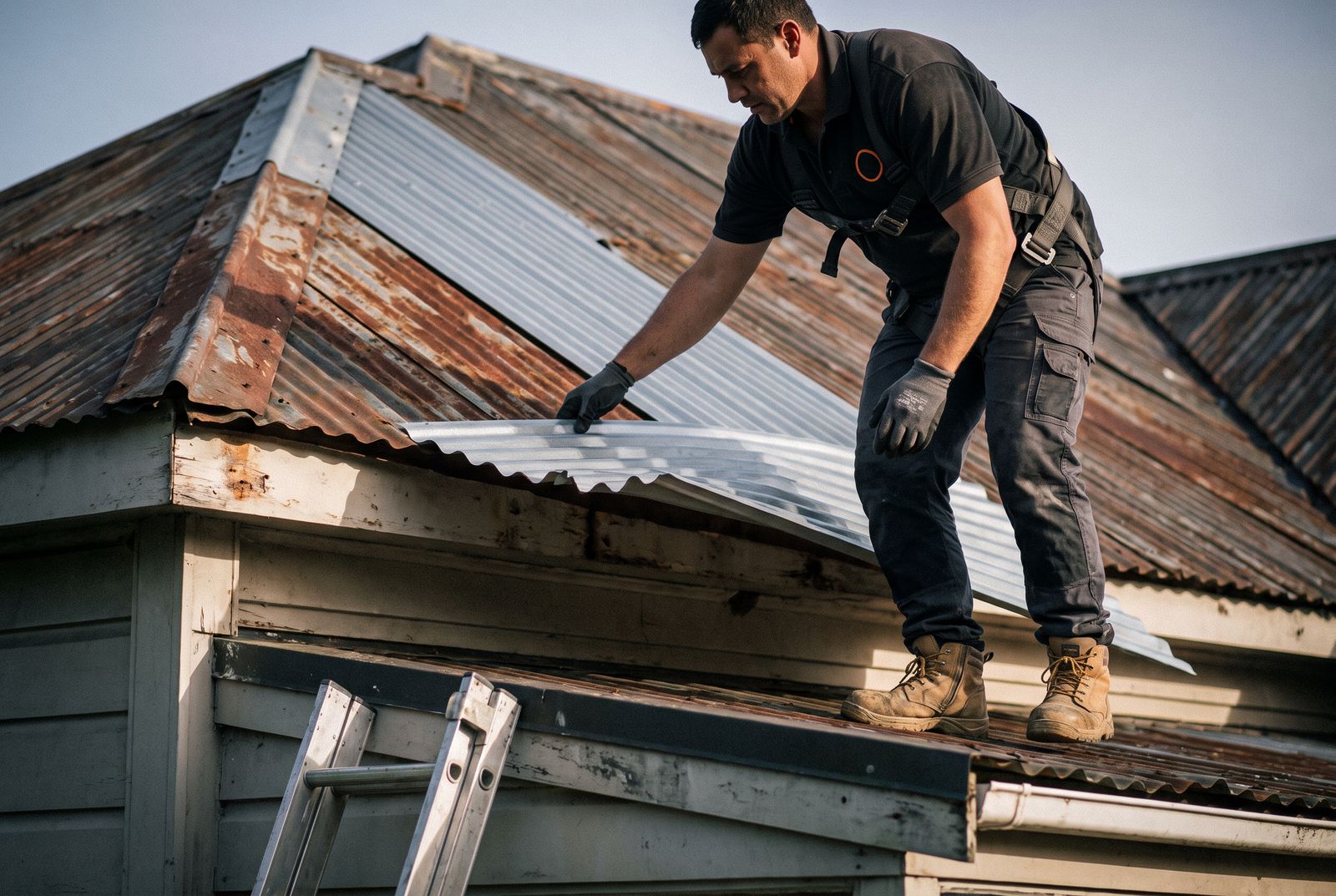
Repairs fall into a few groups. Fixings work loose or corrode. Flashings around chimneys, walls, skylights and valleys crack, lift or rust. Tiles crack or slip. Spouting overflows and pushes water where it should not go. Each needs a different fix.
- Replacing rusted, loose or popped roofing screws and nails
- Replacing individual corroded or damaged steel sheets
- Repairing or remaking apron, barge, ridge and valley flashings
- Resealing or replacing pipe and flue penetration flashings
- Replacing cracked or slipped concrete and clay tiles, and rebedding ridges
- Clearing and repairing blocked or overflowing spouting and internal gutters
Wind is behind many Wellington repairs
NIWA's records for Wellington Airport show gusts above 63 km/h on about 166 days a year. A roof that flexes in wind that often works its fixings loose over time, and the edges of a roof take the most punishment: barge flashings, ridge caps, the ends of sheets and the first rows of tiles. A barge flashing that has lifted a few millimetres is an easy repair now and a peeled-back flashing after the next gale.
When we refix a roof we do not simply put back what was there. NZS 3604 wind zones run from Low to Extra High, and many Wellington sites sit in the High, Very High or Extra High zones, where fixing patterns are tighter and flashing details matter more. Repairs use screws, spacing and flashings that suit your zone, so the fix holds in the conditions your roof actually faces.
How It Works
How we inspect before we repair
A repair is only as good as the diagnosis. We look at the whole roof, not just the spot you pointed out, because the visible problem is often a symptom of something nearby. Where we can safely get into the roof space we check the underside too, looking for water staining on timber and the condition of the underlay.
You get photos and a written explanation of what we recommend and why. If the roof has more life left, we repair it. If repairs would only buy a short time, we say so and price both options. Our roof replacement page explains how we make that call.
Using the right materials near the sea
Repairs fail when the wrong materials are used. Putting a dissimilar metal next to COLORSTEEL or ZINCALUME steel can cause corrosion, and runoff from some materials, such as copper, damages steel below it. The NZ Metal Roof and Wall Cladding Code of Practice sets out which materials are compatible, and we follow it.
Salt raises the stakes. Under NZS 3604, land within 500 m of the sea, including the harbour, is exposure Zone D, so a repair on a house near the water in Petone, Island Bay or Plimmerton may need a different fastener or steel product than one in an inland valley. Sealant has its place, but a gap that needs a flashing does not become weathertight because it has been filled with silicone. Detail work is covered on our roof flashing repairs and tile roof repairs pages.
Do roof repairs need building consent?
Generally not. Schedule 1 of the Building Act exempts repair and maintenance using comparable materials, and replacing components with comparable ones in the same position. That covers most roof repairs.
The exemption does not cover repairing or replacing building elements that have failed the durability requirements of the Building Code, which for roof cladding means a minimum life of 15 years. If a roof has failed early, or the repair involves the structure, we will tell you before work starts whether consent may be needed.
What affects the cost of a roof repair
The size of the repair is only part of it. Access is often the bigger factor, and Wellington hillsides make access a real question: a single-storey roof beside the driveway is quick to set up, while a two-storey house above a steep bank or down a long flight of steps needs scaffolding or edge protection, as WorkSafe's guidance on working on roofs requires. Materials matter too, including whether matching steel or tiles are available.
We quote repairs in writing after inspection, listing several small problems separately so you can prioritise. If repairs are adding up, our roof replacement cost guide helps you compare. For local detail, see roofers in the Western and Northern Suburbs.
Why Choose Cheeky's Roofers for Roof Repairs
Photos before and after
You see the problem and the finished repair, even on parts of the roof you cannot get to.
Refixed for your wind zone
Screws, spacing and flashings suit your site's wind zone, not just what was there before.
Compatible materials
Repairs use steel and fixings that suit your roof and exposure, so they do not start new corrosion.
Straight advice on roof life
If your roof is near the end, we tell you, and price repair and replacement side by side.
Roof Repairs FAQs
How much does a roof repair cost?
It depends on the problem, access and materials. A few replaced fixings on an accessible single-storey roof is a small job. Remaking flashings on a two-storey hillside house takes longer and may need scaffolding. We quote in writing after inspecting.
Why do my roofing screws keep coming loose?
Repeated wind loading flexes the sheets and works fixings over time, and old screws lose their washers. Replacing them with the right fasteners at the right spacing for your wind zone usually solves it.
Can you match my existing roof colour?
We match COLORSTEEL colours where they are still made. Older colours may be a close match rather than exact, and new steel looks brighter than weathered steel at first.
Do I need consent for a roof repair?
Most repairs using comparable materials are exempt. Consent may be needed if the roof has failed its durability requirements early or the repair involves structural work.
Is it worth repairing an old roof?
Often, if the problem is local and the underlay and timber are sound. If problems are widespread, replacement is usually better value.
Do you repair tile and decramastic roofs?
Yes. Decramastic roofs that may contain asbestos are handled carefully and never water blasted.
Roof Repairs by Area
Local roof repairs information for your part of Wellington:
Related Roofing Services
- Roof Leak Repairs
- Emergency Roof Repairs
- Tile Roof Repairs
- Roof Flashing Repairs
- Re-Roofing
- Roof Painting
Roof Repairs Guides
- Rust on Your Roof: Treat It, Paint It or Replace It?
- Chimney Removal in Wellington: Consent, Roof Repairs and Quake Risk
- Roof Rattling in the Wind? Replacing Roof Nails With Screws
See the roof replacement cost guide or every service we offer.
Sources and further reading
- MBIE building.govt.nz: Exemption 1, general repair, maintenance and replacement
- MBIE building.govt.nz: B2 Durability
- NZ Metal Roof and Wall Cladding Code of Practice
- Level (BRANZ): Wind zones
- BRANZ: Metal corrosion and exposure zones factsheet
- NIWA: The Climate and Weather of Wellington
- WorkSafe: Working safely on roofs
- WorkSafe: Check for asbestos before high-pressure spraying on roofs