
Longrun steel is the standard roof for New Zealand homes, and for good reason in Wellington. It is light on the frame, it can run in a single sheet from ridge to spouting with no end laps to leak, and when it is fixed properly it holds firm in wind that would strip lesser roofs. COLORSTEEL is the pre-painted steel brand made in New Zealand for this kind of roofing.
We install longrun on re-roofs, new builds and extensions across the region. The two decisions that matter most in Wellington are which steel product suits your distance from the sea, and how the roof is fixed for your wind zone. If you are replacing an existing roof, see our re-roofing page, and for colour choices see COLORSTEEL colours.
Pricing: every roof gets a free on-site measure and an itemised written quote, with a fixed price agreed before any work starts.
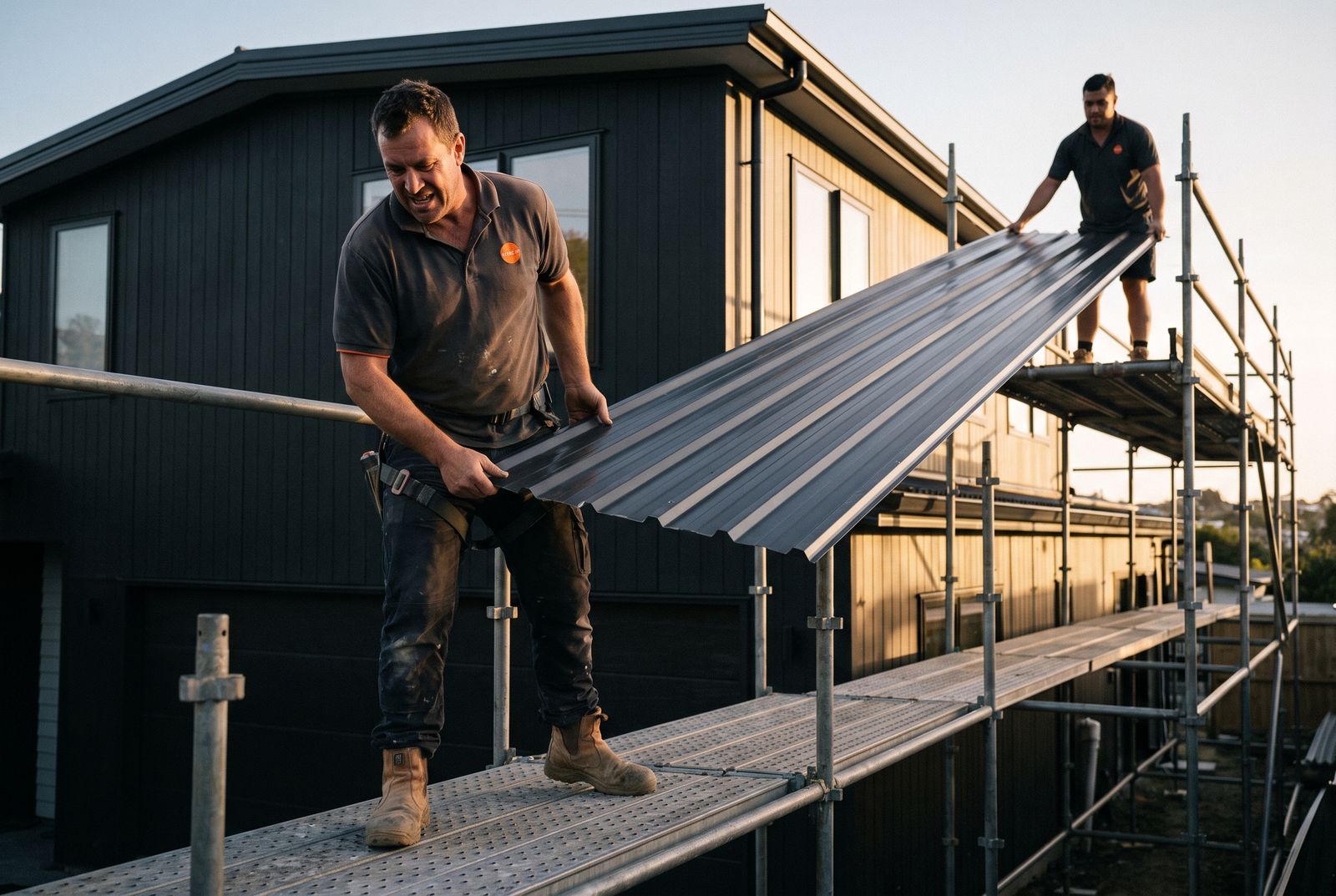
What a longrun roof is made of
A longrun roof is a system, and the sheets are only one part. The steel is rolled to length for each run of the roof, then fixed through the profile to purlins or battens. Under it sits a roof underlay, and at every edge and junction a flashing folded from matching steel.
- Pre-painted steel sheets rolled to the length of each run
- Roof underlay, with safety mesh where the specification calls for it
- Purlins or battens, checked and re-fixed on a re-roof
- Roofing screws with sealing washers, spaced for the wind zone
- Ridge, barge, apron and valley flashings in matching steel
- Spouting and downpipes, often replaced at the same time
Choosing a profile
Pitch decides more than looks. The NZ Metal Roof and Wall Cladding Code of Practice sets minimum pitches by profile. For standard corrugate the minimum is 8 degrees, while deeper trapezoidal profiles can run as low as 3 or 4 degrees depending on rib height. Corrugate suits villas, cottages and bungalows and is the traditional choice on older Wellington homes. Trapezoidal ribs suit modern designs and lower pitches, and they carry more water per sheet.
Run length matters too. Long sheets expand and contract with temperature, and the fixing method has to allow for it. On very low pitches or flat areas steel is not the right answer, and a membrane roof does the job instead.
How It Works
Fixings for Wellington wind
Wind uplift is what pulls roofs off, and Wellington gets more of it than most cities. NIWA records gusts over 96 km/h at Wellington Airport on about 24 days a year, and Hawkins Hill has recorded a 248 km/h gust, the highest in the North Island. NZS 3604 places sites in wind zones from Low to Extra High, with some needing specific design, and the zone sets how many fasteners go into each sheet, where they go and how the purlins are held down.
On a re-roof the fixings are often where the money is best spent. Older roofs were nailed, and the purlins underneath may be fixed far more lightly than today's details require for a high wind zone. We check the zone for your address and look at the framing when the old roof comes off, so the new roof is held down to suit the site and not just the old nail pattern.
Matching the steel to your exposure
Salt is the main threat to a steel roof's life. Under NZS 3604, sites within 500 metres of the sea, including harbours, are generally Exposure Zone D, and breaking surf beach fronts can be Zone E. That likely covers a lot of homes in Lyall Bay, Island Bay, Seatoun, Eastbourne, Tītahi Bay and the Raumati and Paraparaumu beachfront, though the zone should be confirmed for each address with BRANZ Maps. COLORSTEEL publishes environment categories on a scale from Mild to Extremely Severe, with different products and warranty terms for each, and asks that sites within 100 metres of salt water be confirmed with them before a product is chosen.
Coastal roofs also need maintenance. NZ Steel says regular washing is essential where steel is used close to the sea, especially areas rain does not reach, like the undersides of overhangs and spouting. Our roof cleaning page covers washing.
What affects the price of a longrun roof
Every roof is measured and priced individually after a free on-site measure. The main factors are:
- Roof area, pitch and the number of hips, valleys and penetrations
- Steel product needed for your exposure zone
- Removing and disposing of the old roof, and testing for asbestos where relevant
- Purlin, batten and underlay repairs found once the old roof is off
- Scaffolding and edge protection, which costs more on sloping sections
- Site access, including carrying long sheets where trucks cannot reach
Consent, licensing and the Building Code
Replacing an existing roof with a comparable material in the same position is often exempt from building consent under Schedule 1 of the Building Act, provided the old roof met its durability requirement. Roof cladding has a 15-year minimum life under Building Code clause B2, so a roof that failed early, or a change of material or structure, can mean consent is needed. On a new build or extension, roofing is restricted building work under the consent. Your council can confirm what applies, and if your house may be in a Wellington City character precinct it is worth checking the District Plan before changing the roof's appearance. Our new roofs page covers new builds.
Why Choose Cheeky's Roofers for Metal Roofing
Product matched to exposure
We check your exposure zone and confirm the COLORSTEEL product with the manufacturer where the site is close to salt water.
Held down for the wind
Fastener spacing and purlin fixing follow your wind zone, and framing is checked when the old roof comes off.
Single-length sheets
Sheets are rolled to the length of each run wherever access allows, so there are no unnecessary end laps.
Itemised written quote
You see exactly what is included, from underlay and flashings to scaffolding and disposal.
Metal Roofing FAQs
How long does a COLORSTEEL roof last?
It depends on the product and the environment. The Building Code requires roof cladding to last at least 15 years, and COLORSTEEL publishes warranty terms by environment category. Washing unwashed areas extends the life of coastal roofs.
Is corrugate or trapezoidal better?
Neither is better everywhere. Corrugate suits traditional homes and steeper pitches. Trapezoidal suits lower pitches and modern designs, and carries more water.
My house is near the harbour. Which COLORSTEEL should I use?
Sites within 500 metres of the sea, harbour included, are generally Zone D. The right product depends on the exact distance and exposure, and sites within 100 metres of salt water should be confirmed with COLORSTEEL.
Will a steel roof blow off in a Wellington storm?
A roof fixed to suit its wind zone is designed to stay on. Roofs that lift are usually ones with too few fixings, failed nails or weak purlin fixings, which is why we check the framing on every re-roof.
Will a steel roof be noisy in the rain?
Underlay and ceiling insulation reduce rain noise considerably. Fixing sheets properly also stops the rattling that makes some older roofs noisy in wind.
Do I need building consent for a new longrun roof?
Like-for-like replacement is often exempt under Schedule 1 of the Building Act. A change of material or structure, or a new build, needs consent. Your council can confirm for your property.
Metal Roofing Across Wellington
We cover every region: Central Wellington, the Eastern and Southern Suburbs, the Western and Northern Suburbs, the Hutt Valley, Porirua, the Kāpiti Coast.
Related Roofing Services
Metal Roofing Guides
- How Long Does a Roof Last in Wellington Wind and Salt Air?
- Re-Roofing a Character Villa in Wellington: Rules, Materials and Details
- Coastal Roofing in Wellington: Corrosion Zones, Salt and Washing
- Solar Panels on a Windy Wellington Roof: Consent, Fixings and Roof Checks
See the roof replacement cost guide or every service we offer.
Sources and further reading
- COLORSTEEL: product range and environments
- COLORSTEEL: warranty and maintenance
- NZ Metal Roof and Wall Cladding Code of Practice: roof pitch
- NZ Metal Roof and Wall Cladding Code of Practice: environmental categories
- NZ Steel: Design considerations for steel roofing in very severe environments
- BRANZ Maps: corrosion and wind zones
- NIWA: The Climate and Weather of Wellington (2014)
- building.govt.nz: Exemption 1.1 general repair, maintenance and replacement
- Wellington City Council: Building and resource consents