
Flashings are the folded metal pieces that seal the joins in a roof: where it meets a wall, wraps a chimney, turns a corner at a barge or runs down a valley. They are small compared with the roof sheets, but they cause a large share of leaks. When a flashing lifts, rusts or was never shaped properly, water gets past it, and in a Wellington southerly it can be driven a long way in.
We repair and replace flashings on steel, tile and decramastic roofs across the region, using steel matched to your roof and fixings suited to your exposure. If you have a leak and are not yet sure where it comes from, start with our roof leak repairs page.
Pricing: every roof gets a free on-site measure and an itemised written quote, with a fixed price agreed before any work starts.
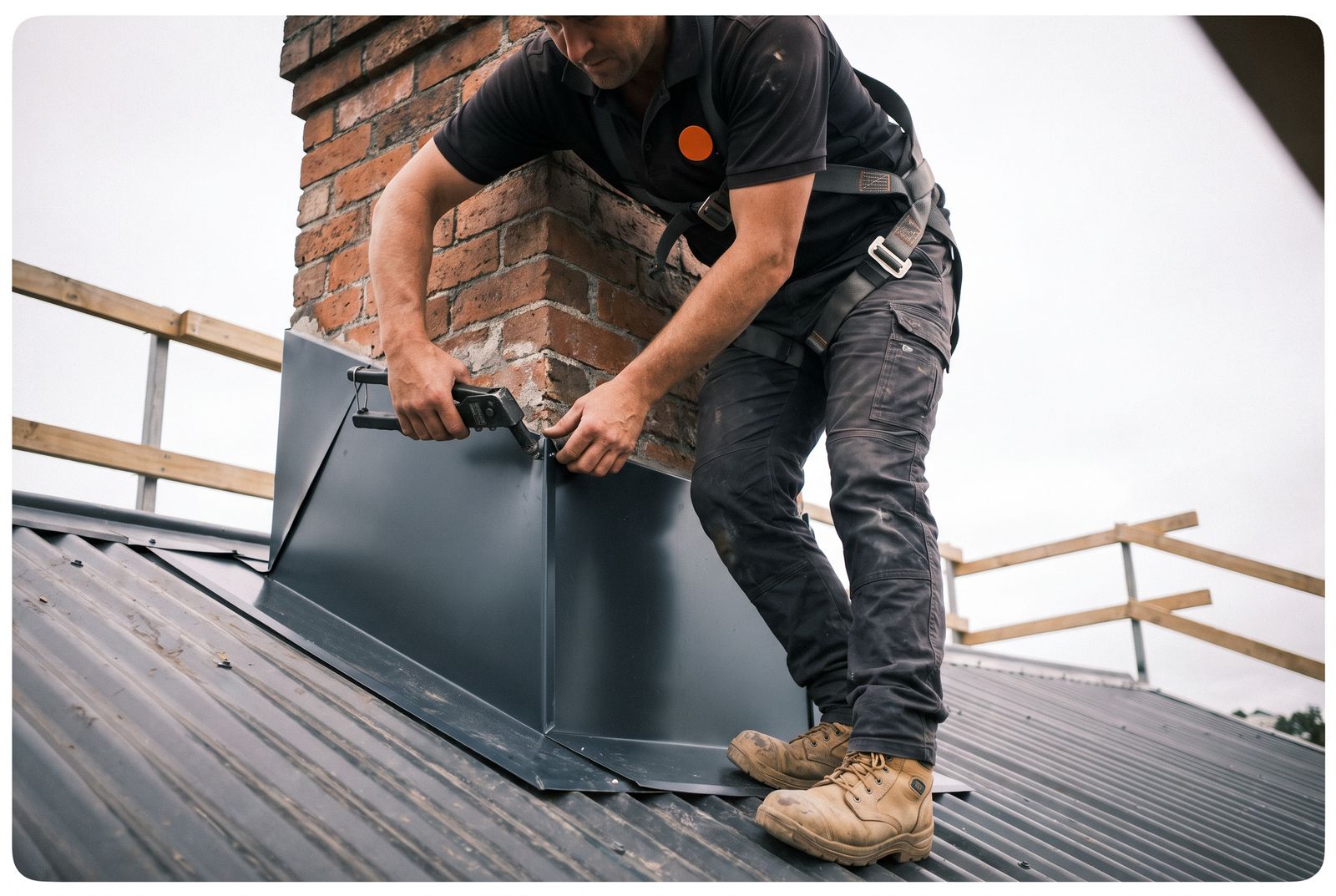
The flashings on a typical roof
Most houses have several kinds of flashing, and each one has its own way of failing. Knowing which one is involved helps explain why a leak only appears in certain weather.
- Apron flashings, where a lower roof meets a wall below a higher one
- Wall or side flashings, running down the slope where the roof meets cladding
- Chimney flashings, including the back gutter on the uphill side
- Barge flashings, along the sloping edges at the gable ends
- Ridge and hip flashings, capping the top joins of a steel roof
- Valley flashings, carrying water where two roof planes meet
- Penetration flashings, around flues, vents, pipes and skylights
Why flashings fail in Wellington
Wind is the main reason. NIWA's Wellington climate summary records gusts over 63 km/h at the airport on about 166 days a year. Every gust tugs at the edges of a flashing, and a fixing that has loosened slightly lets the metal flex until the fastener hole elongates or the flashing lifts. Barge and ridge flashings on exposed gables take the most punishment, along with anything on the windward side of a hill.
Salt is the second reason. Under NZS 3604, land within 500 metres of the sea, harbours included, is generally Exposure Zone D. That covers a lot of housing from Lyall Bay and Island Bay to Seatoun, Eastbourne and the Petone foreshore, though the zone should be confirmed for each address. Salt attacks cut edges, fixings and the undersides of flashings that rain never washes. Old sealant that has cracked, flashings cut too short, and dissimilar metals in contact round out the list.
How It Works
How we repair and replace flashings
Small faults can sometimes be fixed by re-fastening a lifted flashing or replacing a corroded section. More often the right repair is a new flashing, folded to the correct shape with enough cover and the right turn-ups and drip edges, fixed at the spacing the Metal Roof and Wall Cladding Code of Practice calls for in your wind zone. Sealant has a role at some laps, but a flashing that relies on sealant alone will leak again once the sealant ages.
Chimneys deserve a special mention. A brick chimney needs a back gutter on the uphill side to turn water around it, and many older ones have rusted or were never formed properly. Flashings around skylights are usually part of a manufacturer's kit, and our skylights page covers those. Where your roof is near the coast we use fasteners and steel suited to that exposure, so the new flashing does not become the weak point.
Flashings and the Building Code
Building Code clause E2 External Moisture requires roofs to stop water getting into a building, and flashings are a large part of how a roof meets it. The NZ Metal Roof and Wall Cladding Code of Practice is the industry reference for flashing shapes, laps, fixings and material choice by environment. It notes that in high wind categories specific detailing is needed.
Repairing or replacing a flashing with a comparable one in the same position is normally exempt from building consent under Schedule 1 of the Building Act. Work that changes the roof structure or design may need consent, and your council can confirm. In Wellington City that is the council's building consents team.
Flashings on character houses and hillside homes
Villas and cottages in Thorndon, Mt Victoria, Newtown and Brooklyn tend to have chimneys, valleys and several wall junctions, so there are more flashings to look after than on a simple gable roof. Replacement flashings on these houses need to suit the original roof line. If your house may be inside a Wellington City character precinct, it is worth checking the District Plan before changing anything visible from the street.
Hillside access affects flashing work too. A short job on a house with no vehicle access still needs materials and safe access set up, so we look at that during the inspection and include it in the price.
Flashings on a roof near the end of its life
New flashings on a roof that is otherwise sound can add many years of service. On a roof where the sheets are rusting through or the fixings have failed across the whole area, replacing flashings alone only buys time. We tell you which situation you are in and show you photos. If the roof itself is at the end of its life, our re-roofing page explains what a full replacement involves.
Why Choose Cheeky's Roofers for Roof Flashing Repairs
Folded to fit, not sealed over
New flashings are shaped for the junction they protect, with proper cover and turn-ups, instead of relying on sealant.
Fixed for wind and salt
Fixing spacing and fastener type are chosen for your wind zone and exposure zone.
Colour matched
Replacement flashings are made from steel matched to your existing roof colour wherever it is available.
Photos of the cause
You see what failed and why, before and after the repair.
Roof Flashing Repairs FAQs
Can a leaking flashing just be sealed?
Sometimes as a short-term fix, but sealant ages and cracks, especially in sun and wind. A flashing shaped and fixed correctly is the lasting answer.
Why does my flashing only leak in a strong southerly or northerly?
Wind-driven rain can be pushed up and under a flashing that is too short or has lifted. It stays dry in calm rain and leaks in a storm, which points to a cover or fixing problem.
What is a back gutter on a chimney?
A small gutter on the uphill side of a chimney that diverts water around it. Missing or rusted back gutters are a common cause of chimney leaks.
Do coastal homes need different flashings?
They need steel, fasteners and coatings suited to the exposure zone. Homes within 500 metres of the sea or harbour are often in Zone D, which should be confirmed for the address.
Can you match my roof colour?
Usually. Most current COLORSTEEL colours are available for flashings. Faded roofs will not match new steel exactly at first.
Do flashing repairs need building consent?
Like-for-like repair or replacement is normally exempt under Schedule 1 of the Building Act. Your council can confirm for your property.
Roof Flashing Repairs Across Wellington
We cover every region: Central Wellington, the Eastern and Southern Suburbs, the Western and Northern Suburbs, the Hutt Valley, Porirua, the Kāpiti Coast.
Related Roofing Services
Roof Flashing Repairs Guides
- Why Does My Roof Only Leak in a Southerly? Wind-Driven Rain Explained
- Chimney Removal in Wellington: Consent, Roof Repairs and Quake Risk
- Re-Roofing a Character Villa in Wellington: Rules, Materials and Details
See the roof replacement cost guide or every service we offer.
Sources and further reading
- NZ Metal Roof and Wall Cladding Code of Practice: environment and durability
- MBIE building.govt.nz: E2 External Moisture
- MBIE building.govt.nz: Exemption 1, general repair, maintenance and replacement
- BRANZ: Metal corrosion and exposure zones factsheet
- NIWA: The Climate and Weather of Wellington (2014)
- Wellington City Council: Building and resource consents