
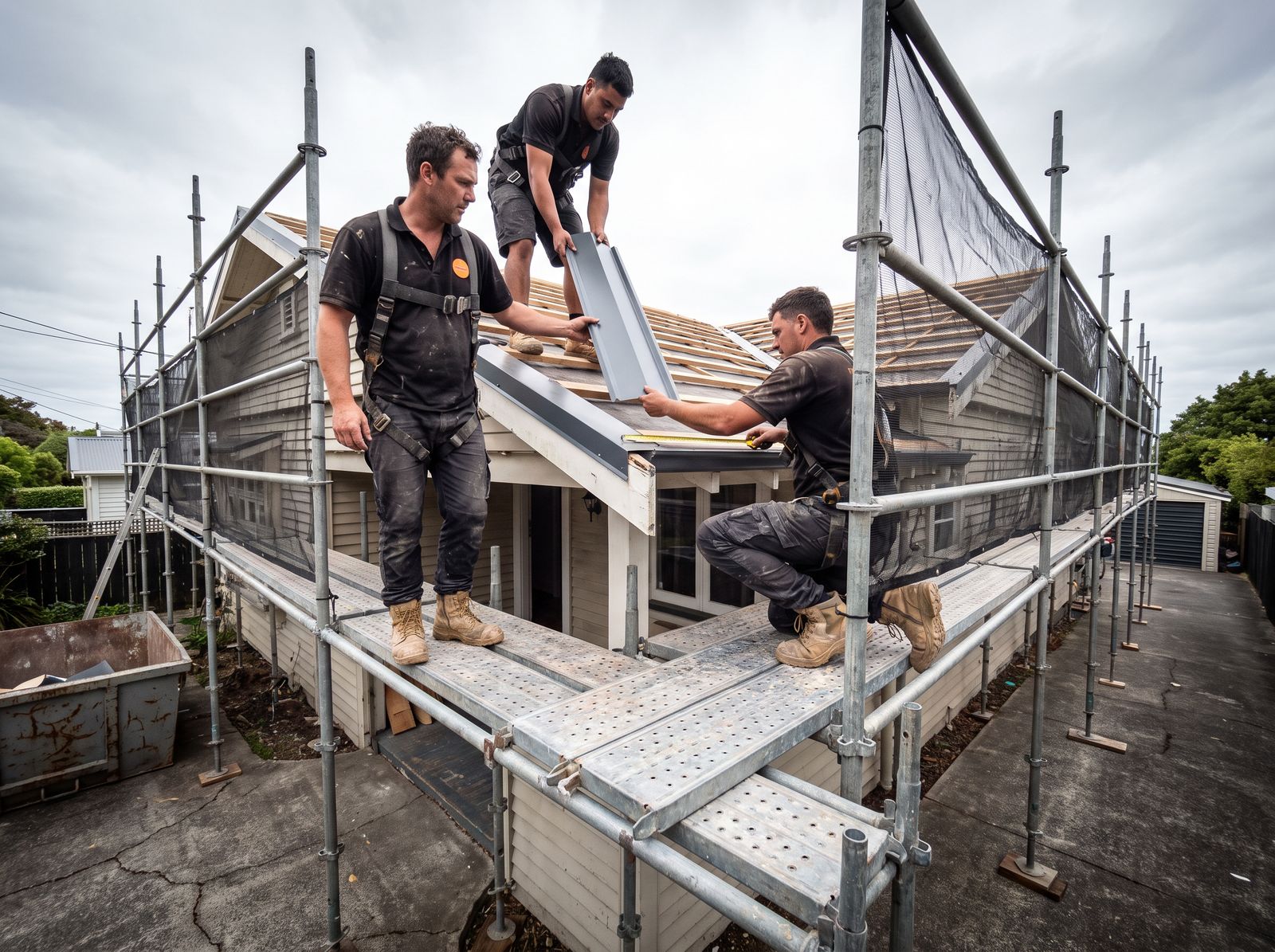
Plenty of Wellington homes sit well above or below the street, reached by a long flight of steps, a shared path or a zigzag track through the garden. That is part of the appeal of a hill suburb, and it is also the first thing a roofer looks at when pricing a re-roof, because every sheet, screw and bag of waste has to travel that route twice.
This guide explains how materials reach a house with no road access, when scaffolding for a roof is needed and who can put it up, what a steep site does to the cost, how the weather sets the programme, and what to sort out with neighbours and the council before work starts. For the work itself, see our re-roofing page.
How do roofers get materials to a house with no road access?
There are three usual ways: carry it, hoist it or lift it by crane. Which one suits your house depends on the distance and height from the nearest place a truck can park, the width of the path, and whether there is open space next to the house for a load to land.
Longrun steel is rolled to the length of each run of roof, so a sheet can be several metres long. Carrying long sheets up narrow steps with tight turns is slow and needs extra hands, and on a gusty day a sheet behaves like a sail. Where the route is short and straight, hand carrying is often still the simplest answer. Where it is long or steep, a powered materials hoist or a ladder hoist set up on the slope can move sheets, flashings and underlay rolls with far less handling.
A crane is the other option for homes below a road or across a gully. It needs a safe place to set up and usually a temporary traffic management plan, which the crane company normally organises, so it is booked well ahead. The same route works in reverse for the old roofing, which has to come off the site as well.
- Distance and height from the nearest truck parking to the house
- Width and turns of the path or steps
- Clear landing space beside the house for sheets and waste
- Whether a crane can set up safely on the road above or below
Do I need scaffolding for a re-roof?
In almost every case, yes. WorkSafe's guidance on working on roofs sets out a clear order of controls: do as much work as possible on the ground, then isolate people from the edge with scaffolding or edge protection, and only then rely on harness or net systems. For a full re-roof, where crews spend days moving across the whole roof, a scaffold with edge protection is the practical way to meet that.
WorkSafe also says scaffolding must be put up by a qualified scaffolder where any part of it is five metres or more above the ground. On a hillside house that point is reached quickly, because the downhill side of a single storey home can be a long way above the ground below it. Scaffold on a slope needs level footings built up from the low side, ties back to the house, and sometimes a design that steps down the bank.
The scaffold earns its keep twice: it is the safe edge for the roofers and a working platform for any new spouting, fascia or downpipes while access is already in place.
Does a steep site add to the cost of a new roof?
Usually it does, because access adds labour, equipment and time rather than materials. The roofing, underlay and flashings cost the same on a flat street as on a hilltop; what changes is how long it takes to get them there and to make the site safe. That is why two houses with the same roof area can be quoted quite differently.
We do not publish a per square metre figure for hillside work, because the access is different at every address. The table below shows what moves the price so you can compare quotes on the same basis. For a general starting point, our roof replacement cost guide covers the main costs of a typical job.
| Access factor | Why it changes the quote |
|---|---|
| Distance from the road | More carrying time for every sheet, flashing and load of waste |
| Steps or a steep path | Extra crew or a materials hoist to move long sheets safely |
| Height on the downhill side | Taller scaffold, more ties and a qualified scaffolder |
| Uneven or soft ground | Built-up footings and more scaffold components |
| Crane lift needed | Crane hire plus traffic management on the road |
| Footpath or neighbour's land used | Council licence or a written neighbour agreement |
Hillside house, tricky access?
Cheeky's Roofers walks the route from the road at a free measure and puts the access plan, scaffold and timing in a written quote.
How does Wellington wind affect re-roof scheduling?
It decides which days the old roof can come off. NIWA's climate summary for Wellington records gusts over 96 km/h at the airport on about 24 days a year, and gales can arrive in any month, though they are most frequent in winter. Those are not days to have loose sheets on a scaffold or a roof open to the sky.
Good scheduling strips only as much roof as can be closed in the same day, with new underlay and steel going on behind the strip-off. Sheets are stacked and strapped down, waste is bagged or bundled as it comes off, and the forecast is checked every morning. A hillside house adds a twist, because exposed sites near ridges can be far windier than the street below. On a steep job it is normal for the programme to include weather days, and a good roofer will move a start date rather than open a roof into a forecast gale.
If the timing matters to you, for example around a sale or a tenancy, ask how weather days are handled in the quote.
Do I need my neighbour's permission for scaffolding?
You need their agreement if any part of the scaffold, a hoist or the crew's path has to go on their land. On narrow inner-city sections that is common, because the side yard between houses can be too tight for a scaffold base. Ask early, explain the dates and how their property will be protected, and put what you agree in writing.
If a neighbour refuses, sections 319 and 320 of the Property Law Act 2007 let an owner apply to the court for an order to enter neighbouring land to do work on their own building, after giving at least five working days' written notice. That is a last resort; a clear plan and a friendly conversation usually work better.
Public land has its own rules. Wellington City Council requires a Road Usage Licence (Footpath) for scaffolding on a footpath, and work on the road itself goes through a Corridor Access Request. Other councils in the region have their own processes, so check with yours. Your roofer or scaffolder will normally handle these applications.
Which Wellington houses have the trickiest roof access?
The hardest jobs are usually older houses on narrow sections climbing a hill, with no off-street parking and little space beside the house. In Mt Victoria, homes sit on the slopes of Mount Victoria with minimal side yards, and on the ridges they tend to be taller and narrower, which means tall scaffold in a tight gap. Brooklyn's housing climbs the eastern slopes above Happy Valley, so many homes are reached by steps from the road.
Further out, Karori and Khandallah are hill suburbs where homes are often set above or below the street. Each of these suburbs has plenty of easy sites too. The point is that access is decided house by house, not by postcode, which is why we walk the route from the road before quoting. If you are in the inner city, see our page for roofers in Central Wellington, and for Karori, Khandallah and the northern suburbs, our Western and Northern Suburbs page.
When should you call a roofer about a hillside re-roof?
Call once you know the roof is near the end of its life, and before the next run of winter weather. Planning access, booking scaffold and arranging any council licence or crane takes time, so an early measure gives you the most choice of dates. If you are not yet sure whether to repair or replace, our roof replacement guide covers that decision.
Cheeky's Roofers includes an access plan in every hillside quote: how materials will reach the roof, what scaffold is needed, who applies for any footpath licence and how weather days are handled. The measure is free and the quote is written and itemised, so you can see exactly what the access costs. You can book a free measure online at a time that suits you.
Frequently Asked Questions
How long does scaffolding stay up for a re-roof?
It stays up from before the old roof comes off until the last flashing is fixed and the site is cleaned. On a hillside site, add the time to build and dismantle a taller scaffold and any weather days. Your quote should state the scaffold hire period and what happens if weather stretches it.
Can the old roofing go down the same path?
Usually, yes. Old sheets are cut into manageable lengths, bundled and carried or hoisted down, then taken away by truck. Where a crane is used for the new roof, it can often lift the waste out in bins on the same day, which saves a lot of carrying on steps.
Will scaffolding damage my garden?
Scaffold footings need firm, level ground, so some plants on the base line may need to be tied back or moved, and boards are laid to spread the load. Mention any plants or paving you care about at the measure so the scaffold layout can avoid them where possible.
Can a re-roof go ahead in winter?
Yes, but expect a looser timetable. Winter is the wettest season across the Wellington region and gales are most frequent then, so crews strip less at a time and keep more weather days in reserve. Spring and summer give more working days, which is why they book up first.
Who is responsible if the scaffold blocks the footpath?
Whoever erects it on the footpath needs the council's permission first. In Wellington City that is a Road Usage Licence (Footpath), and a clear walkway has to be kept for the public. Your roofer or scaffolder normally applies, but it is worth confirming that in the quote.
Our Services
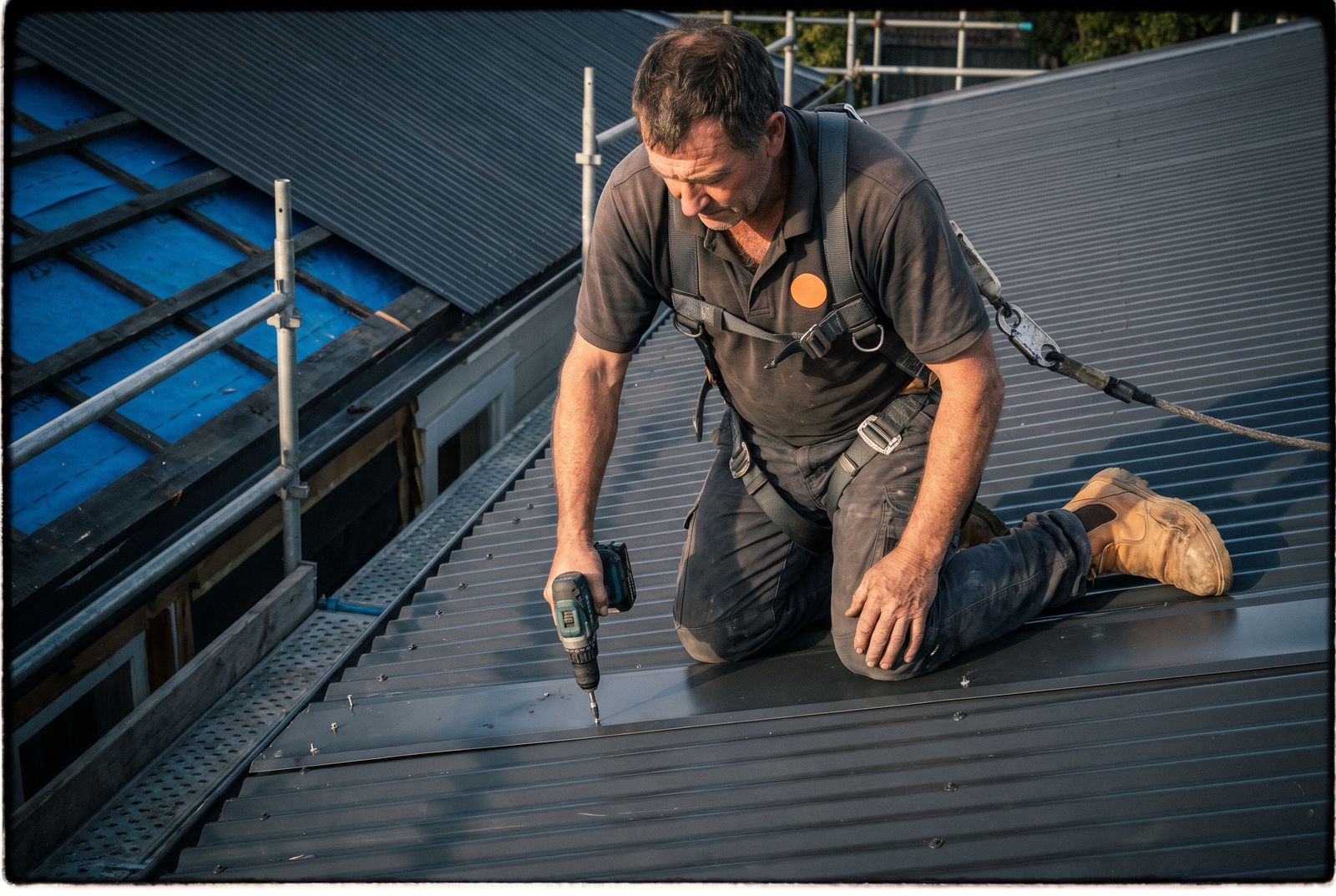 Re-RoofingA full re-roof replaces your old roofing, underlay and flashings with a new COLORSTEEL roof built to today's Building Code.
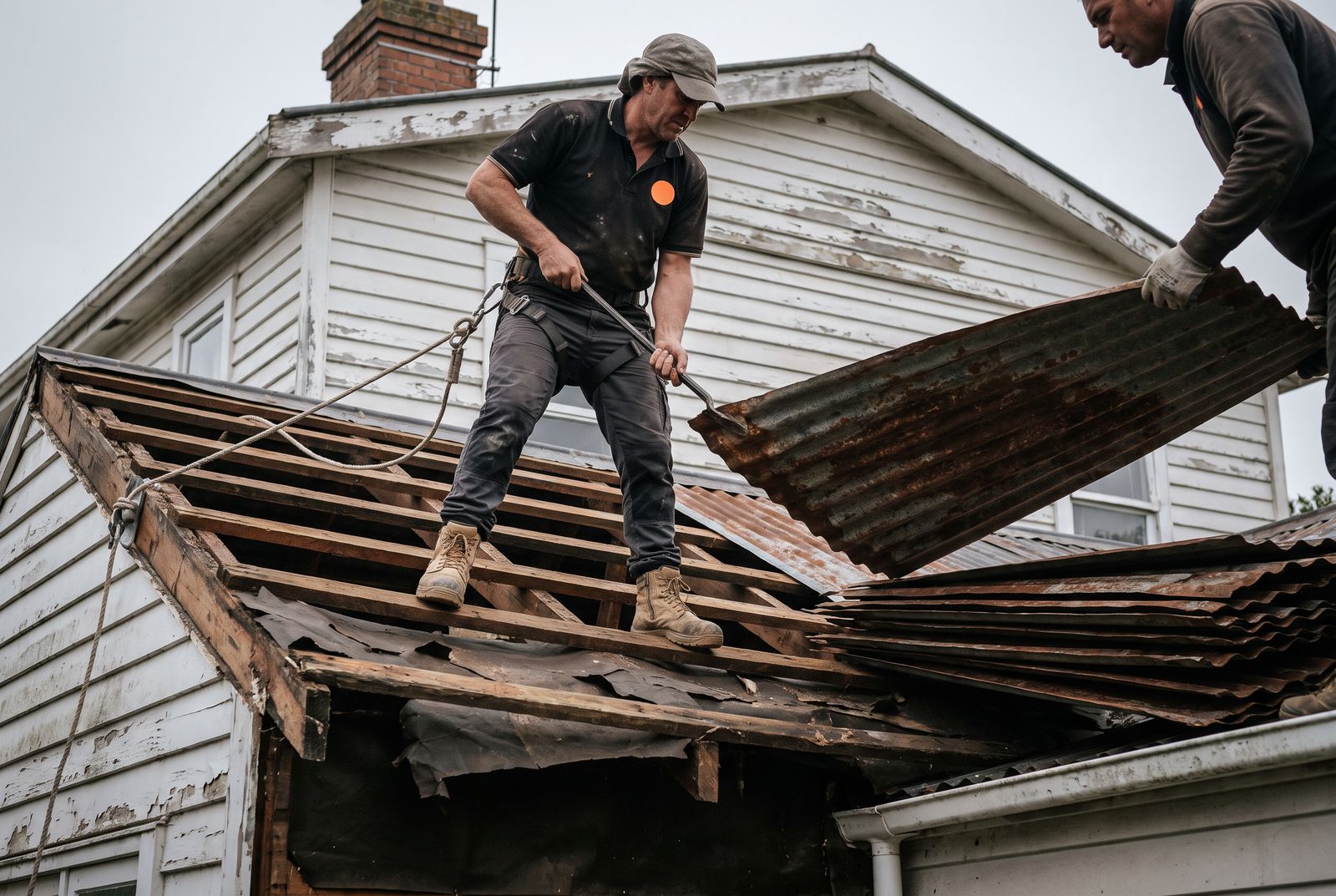 Roof ReplacementWhen repairs no longer make sense, we replace the roof completely and leave you with a roof that is good for decades.
Read Next
How Long Does a Roof Last in Wellington Wind and Salt Air?
The Building Code sets a floor of 15 years for roof cladding with normal maintenance, and a well-chosen, well-kept steel...
Read article
Re-Roofing a Character Villa in Wellington: Rules, Materials and Details
A Wellington villa can be re-roofed in new corrugated steel that keeps its character, and original details such as a bul...
Read article
Solar Panels on a Windy Wellington Roof: Consent, Fixings and Roof Checks
Most rooftop solar in NZ no longer needs a building consent. Since 23 October 2025, arrays up to 40 square metres in a w...
Read article